Tuesday, July 27, 2010

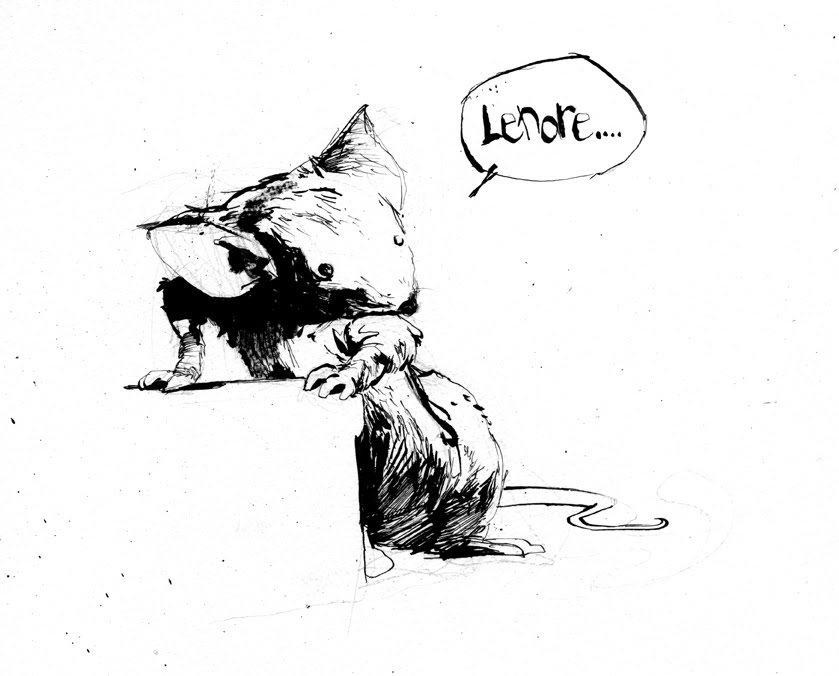
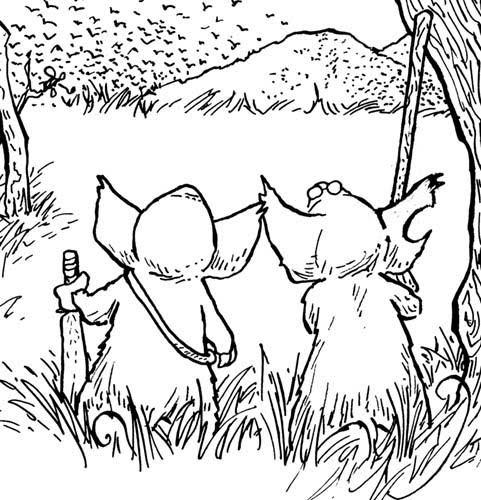
Legends of the Guard Creator Spotlight: Katie Cook

David Petersen: Katie, while I figure most people already know about you and your work, talk about the work you do and are best known for.

Katie: Well, I guess I'm most known in the Star Wars fandom for doing things like "how to draw" activities for starwars.com and and their live drawing classes at the San Diego Comic Con, as well as the online comic for Star Wars: the Clone Wars and countless pieces of art for Star Wars trading card sets! i've also done trading card art for DC, Marvel and Lord of the Rings. Currently, i'm very happily working on the Fraggle Rock comic. (oh! and I guess I'm also known for putting cats into everything. It's not a gimmick.... I just like cats.... a lot.)
David: How was working on a Mouse Guard story different than working on a Fraggle or Clone Wars story?

Katie: Mouse Guard stories have more clone troopers. Wait, I think that's the other way around... But really, I love Star Wars. I really do, but with that, I'm working with characters that are already established and have a history that I am in no place to mess around with. Creating this story for Mouse Guard was more freeing because I was coming up with a small group of characters of my own and making them fit into the world of MG. Also, mice are WAY more fun to draw then clone troopers.
David: I know with the Fraggle stories you have worked on, you have worked in a square format before. How do you like it? Do you find it strange to switch back to traditional format for other projects?

Katie: I actually really love the square format. I hate to put it this way but I think squares are cute. (That probably came off sounding as stupid as I think it sounded when i typed it) But really, they are. And I think that you get to have a lot more fun composing a page in a square format. I also really like that, since i'm drawing on a 12"x12" sheet of board, it will fit on a drawing board that i can position on my lap so i can draw while i sit on the couch and watch a movie!
David: So with you being the Queen of Cute, I knew we were going to get an adorable Mouse Guard story from you. But even within your body of work, there is a range of cute-ness, sometimes you aim for a more serious look, other times a so-cute-it-hurts approach. Where does your Mouse Guard artwork fall in there and why?

Katie: I am the Picasso of cute! But, like every artist tortured by visions of cute kittens and fuzzy otters, I have a much deeper, darker side hiding within. The approach I'll be taking with my MG story isn't going to be Bambie-eyed, chubby-cheeked adorable mice with singing songbirds whirling about their heads as they skip merrily through a meadow, it'll be story appropriate (because my story is a little serious!) but, since it is ME we're talking about, I don't think I can get around it being cute at it's core.
David: Mark Smylie had given me a few suggestions for his story. One of them felt like a pure Katie Cook tale, so after asking Mark, we offered it to you as a springboard for your story. However, you offered up a story of your own that I loved even more. Where did that story come from?

Katie: First, I have to say that i did LOVE Mark's idea. I was totally sold on it for a while after you told me about it. But, I also wanted to you see the other story idea that I'd had. Back in college, I took a 300 level English class that was the study of fairy tales and folk lore from around the world... since then, I've really loved reading tales from all over the place. I wanted to write a classic folk tale for the MG universe. So, after i sat and thought about what "lesson" I wanted my story to have, I wrote a story around that. (actually, I wrote a story, hated it, deleted it, then wrote a different one. THAT'S the one I showed to you)

David: I was really impressed by how nicely it all fit together, I wondered if it was based on a real fairy tale. It felt that Authentic. I think it's so great that was intentional.

Katie: Like i said before, I love to read fairy tales, so I've done my research! It's not really based on any one tale in particular, it's more like pulling from a little of column a, a little from column b, a dash from column c and tossing it together with a nice vinaigrette. One of the things that class taught me was how to structure a fairy tale, so I really just followed that so it would have a really classic feeling to it. (Though I did sit down for a while and REALLY think about how i could adapt "The Soldier and Death" into a MG tale, I thought about it for days... but it just wouldn't have worked. boo)
David: Let’s talk about process. How do you take your script to a drawn & inked page? Feel free to talk about materials and supplies.

Katie: As much as I love my Cintiq, I still hand draw all my pages before taking them onto the compute to color them. I draw everything out on Strathmore Smooth Bristol Board using a plain ol' .5 mechanical pencil, then ink using an 01 micron pigma pen. after that, I scan everything into Adobe Photoshop CS4 and color! Although, I do sometimes now do all my roughs on the computer. I just pull up my script in one window, photoshop in another and doodle away on the screen.
David: Since you know you will be coloring the work, does that affect the way you ink? How do you decide when to let the ink or when to let the color do the work?

Katie: My inking style is pretty basic. I like my line work to be clean and meticulous. so, mostly, i just go crazy coloring it later on. I'd much rather have the "undo" button on my side instead of going crazy inking the page and going... "oops, wish i hadn't just put that there..."
David: Speaking of color, What kind of process did you use to color your Legends story?

Katie: After I scan in the black and white art, I flat out all my colors. Then I build shadows, highlights and textures on separate layers from there. My files always have a million layers, it's crazy. i seriously have layers named things like "shadow 2 for rock #4", "flesh highlight 3 nose" and ""wemb trop patn lft shldr". *I* know what it means though, so it's all good.
David: Where can people find out more about Katie Cook and all she’s up to?

Katie: Why they can just visit http://www.katiecandraw.com/! there are also link to my twitter, facebook fanpage, deviantart and more on my site :)

Katie's Story 'A Mouse called Fox' appears in Legends of the Guard issue 3.

Tuesday, July 20, 2010

Spotlight on Legends of the Guard creator: Jason Shawn Alexander:
David Petersen: Jason, You lead two different artistic lives it seems, one as a comic book artist and the other as a fine art/gallery show painter. Do you see these as being very different or is creating work all part of the same process for you?

Jason Shawn Alexander: Right now they are very different. Aesthetically, socially, and in my process. My personal work has no story to tell. If it does, it's subconscious. It's becomes more and more abstract. It's a release. It has a thought process that is very personal and very private. Very different from comics. My comics work is what I do, not for fun, but for pure enjoyment. there's a difference. The process of visual story-telling is incredible to me. I know I'll do it till the day I die. I would just like to break the seal and do nothing but my own stories. But that includes getting to run wild with other titles, like Mouse Guard.

David: How did working on your Legends story differ from your other comic work like Abe Sapien: The Drowning, or Damn Nation?

Jason: Because it's my story, well, it was up to me to write/adapt. I love nothing more than being in control and laying out my own pages without a panel by panel script. The story-telling aspect is the pay-off for me.

David: How did you come to the idea of doing an adaptation of an Edgar Allen Poe story?

Jason: I've wanted to adapt this poem for so long, but who wants to see another gothy Johnny Depp and crows.....well, I'm sure a lot of people, but not me. When MG came along, it rang out perfectly. A truly unique take on an icon of loneliness and despair.

David: Can you talk about your process? do you thumbnail? do you work directly on the final paper surface?

Jason: I thumbnail. That's how I script. Even when I full write my own stories, I write them in screenplay form. The panel by panel portion comes from me reading and pacing it out in thumbnails. Then very loose pencils and the the rest is all quill and ink.

David: What materials do you use to pencil and ink with?

Jason: A cheap mechanical pencil. Sharpening pencils irritates me. Then a Gillott 303 nib. Nothing has proven better for me and I've tried tons. I still buy new brands of nibs to see if anything works better for some things, but nothing has. Ink is different. I use a LOT. So I buy cheap. I buy Blick brand Black Cat ink for my nibs and then Speedball ink for my solid black brush work. All on Strathmore 400 series water color paper. 15x22 in.

David: Would you say most of the ‘work’ is in the penciling or the inking? That is to say, are your pencils just a guide for the ink work, or are your pencils a tighter recipe for where the ink needs to go?

Jason: Everything happens in the ink. If I pencil too much it becomes stiff and I feel like I'm tracing. I need that fear to keep me focused and excited.

David: Where can people find out more about you and your work Jason?

Jason: www.bloodandwhisky.blogspot.com/ or http://www.jasonshawnalexander.com/
Jason's story appears in Legends of the Guard issue 3

Tuesday, July 13, 2010

Blog Post between Legends Spotlights...
With the Legends spotlights running the week before an issue comes out and then the 2-3 weeks after, this will be my last personally written post before heading to San Diego (comic con info below). So I hope I tackle everything...and check back next week when the Legends interviews start back up again with Legends #3 creators: Katie Cook, Jason Shawn Alexander, Nate Pride, & Guy Davis.

Black Axe # 1 in previews:
With Black Axe being offered up in previews (order code: JUL10 0766) and due in September, I thought this would be a good time to share the cover image with everyone. Here is the solicitation text:
Mouse Guard returns for its third volume: the Black Axe. This prequel set in
1115, fulfils the promise the wise oldfur Celanawe made to tell Lieam of the
day his paw first touched the Black Axe. The arrival of distant kin takes
Celanawe on an adventure that will carry him across the sea to uncharted
waters and lands all while unraveling the legend of Farrer, the blacksmith
who forged the mythic axe.


July Ink & Stein:
At the last Ink & Stein, I was confused and mentioned that the July event would overlap with San Diego...well as I say, I was confused, because it doesn't! Ink & Stein a a group of artists who gather to draw the 3rd Sat. of every month at the Eagle Crest Marriott Lounge in Ypsilanti, MI from 7pm-11pm. If you live in the area and want to come to this or any month's gathering, please do!

Scouting:
A few months ago I was contacted by a scout troop because a fan of mine was receiving his Eagle rank in the Boy Scouts. Scouting and Mouse Guard are closely connected in my mind. I was a Boy Scout from age 11-18 and earned the rank of Life Scout. It was in scouting that I met who would later become my best man, the inspiration for Kenzie, and a friend for life. He and I formed the relationship on scouting events, that would become how I write the dynamics of Kenzie and Saxon. And on a larger scale, many of my scouting experiences: making shelters, hiking, winter camping, cannoning, leadership, and a system of peer-rank advancement, shaped how the Mouse Guard itself functions.

SDCC info:
Here are the basics: I'll be in Artists Alley at GG09 for most of the show (with my new Celanawe banner!) There I will be signing books, posters, sketchbooks.

I'll have several signing times at the Archaia booth as well (TBA*). On Sunday the 25th, at 2:30 pm in room 3, There will be an Archaia All-Ages panel featuring Legends of the Guard, Black Axe, and several other Archaia titles like Return of the Dapper Men and Fraggle Rock. Joining me for the Mouse Guard related discussion will be Jeremy Bastian, Katie Cook, and Karl Kerschl.
*Check my twitter status for updates on signing times

Fan Art:
This piece was sent by Sebastien Cormier. Thanks Sebastian!

Upcoming Appearances:
San Diego (Artist Alley): July 22-25
Baltimore Comic Con: August 28-29
New York Comic Con (Archaia booth): Oct 8-10
Mid-Ohio Con: Nov. 6-7

Tuesday, July 6, 2010

Spotlight on Legends of the Guard creator: Terry Moore:
David Petersen: Terry, When I asked if you would be interested in doing a Legends story, you mentioned that you had kinda sworn off anthologies. Why is that? and what made you change your mind for this project?

Terry Moore: I found that I would spend a lot of time on an anthology contribution, then nothing would come from it, like nobody ever saw it. You know, like nobody ever said they saw it or anything. And I have to work overtime to do one, because every month I have a new comic issue due. So it just got to where I didn’t think it was worth it anymore. But, with Mouse Guard, that was a no-brainer because I love the book and, as a cartoonist, I knew I would love drawing the mice in their world. So, I guess I do anthologies, but now I’m very, very, very picky.
David: I sought out storytellers for this project, that is to say folks who were both artists and writers. With Strangers in Paradise and now Echo you are well known for being a storyteller of his own worlds, but every now and then you play in someone else’s toybox (Birds of Prey, Darkness/Vampirella, Spiderman Loves Mary Jane). Do you find it a relaxing vacation for having the weight of your own worlds on your shoulders? or does it have it’s own stresses of making other people happy and working within the confines of cannon?

Terry: It’s a fun break, to think about other worlds and other characters. It does add stress to my life though because, again, the relentless deadline of my own book. I usually don’t get to do one or the other. It’s usually add something to the existing workload, so it has to mean something to me or I can’t do it.

David: Your story, The Shrike & the Toad is about clever thinking, and making the best of a bad situation. Where did the story come from?

Terry: I just put myself in their shoes, the guardmice, and tried to think of something that might easily happen during the course of the day, to show the resourcefulness of these special little creatures. And I use to draw cartoon toads all the time, so I snuck my fave critter in there. FYI: this was the first time I’ve ever drawn a mouse, but it was great, following your wonderful design/style.
David: The story outline you turned in was fairly long considering you had a two page page limit. I was worried that while I liked your story, it could never fit on two pages. However, you turned in the final art on two pages and I don’t see that you left anything out! How did you tackle taking a typed story outline and planning it out to work within a small page count?

Terry: Ha! That’s the story of my work life! I write out long scenes for my books, letting characters talk things out, saying too much and all that. Then when I sit down to draw I edit and toss out the unnecessary stuff, and it’s always much shorter and tighter. I like for everything on the page to belong there for a reason. As Strunk & White said, “Kill your darlings.” Meaning: edit out the fluff, even if you like it.
David: What is your process for getting artwork to the final surface? Do you draw directly onto it? do you print out blue lined sketches? do you use a light box?

Terry: I almost always draw and ink straight to the page, so no blue-line sketches or anything. In the case of The Shrike And The Toad, I did a loose thumbnail of the panel layout on printer paper, but there weren’t characters or anything. I threw it out when the real pages were finished. As for a light box, I use one to mark off the measurements of my comic page template. I made a master that I use on the light box. That way I don’t have to measure off every page.
David: And for your linework, what do you use to ink with?

Terry: For Shrike and Toad, I used a 102 quill pen (for art and lettering) that was so broken in it gave out on the final panel. I was inking the tree on the right and a big blob of ink just fell out of the nib. I was horrified because I tried very hard not to have any mistakes on the art. Fortunately I was able to clean it off and cover it up. For my books I use the quill for all but the large figures. For those I use a Raphael #1 brush.

David: I noticed a Charles Schulz-ness to the artwork for The Shrike & the Toad and I see you have mentioned before that Peanuts was an influence on your work. Can you describe how Sparky’s work influenced you and this story?

Terry: Every time I draw grass and trees I think of Peanuts. Sparky most of his life staring at the details of his cartooning as he worked, refining his art to the best look. I’ve spent my life looking at his art too. So, it’s inevitable you would see the influences. That’s why you have to be careful what you put into your brain, as an artist. When you see great stuff, devour it. That’s what I learned from Schulz. That’s why I loved contributing to this book!

David: The square format is one that I really enjoy working in and I’m finding that the other creators for Legends have enjoyed it and found it challenging. How did you find working in it? Did it affect your layout process?

Terry: Square is so much better for me than the vertical format. More natural. Maybe I took to it so easily because it more closely resembled the notebook paper ratio I drew on during school. That’s where I learned to cartoon, in jr. high and high school, making thousands of cartoons on my notebook paper. Never thought I’d say this but, square is cool! 
David: Where can people find out more about Terry Moore, Strangers in Paradise, and Echo?

Terry: The FBI website usually has something. Or go to my website: abstractstudiocomics.com

Terry's Legends story: The Shrike & the Toad appears in
Legends of the Guard issue #2 in stores June 23rd

Tuesday, June 29, 2010

Legends of the Guard Creator Spotlight: Sean Rubin & Alex Kain:

David Petersen: Alex, fans of Mouse Guard may not be as familiar with your name as some of the other creators on Legends of the Guard. Let’s correct that. Tell us about yourself and your work.

Alex Kain: By day I'm a video game designer and writer for Venan Entertainment, Inc, a small studio in Connecticut. Since I joined up with Venan, I've helped design over a dozen games ranging from NBA LIVE and Monopoly on the iPhone to Ninjatown on the Nintendo DS. Recently, I served as a designer and lead writer for the iPhone game "Space Miner: Space Ore Bust".
By night, I'm usually working on comic-related side projects. I wrote a lot of standard novel-format stories in high school and college, but nothing has ever been quite so rewarding as seeing those stories come to life in comic book form.

David: Alex, with background is in video game design. In what ways do your game designer skills coincide with writing a 10 page comic story?

Alex: I was actually pretty surprised when I found out there were quite a few similarities between comic writing and game design! Most of the material I write for Venan has to fit comfortably on very tiny screens, so that's taught me to keep things short. Altogether a pretty handy frame of mind to be in when you're writing a script for equally-restrictive comic panels. Whether it's comparing comic panels to tiny tutorial pop-ups or page counts to memory limitations, comics and games require creativity in how we approach these restrictions. Another thing I brought over from my design work is that I try not to get too attached to anything I write - things are constantly changing and improving, and the story has to move quickly to keep up with the rest of the production.

David: Sean, tell us about yourself. You are known for your work on Redwall, but tell us more. Where did you go to school? How did you ‘break in’ to illustration?

Sean: Well, I had planned on going to art school for most of my childhood, but when I started talking to illustration professors, many of them thought that my interests were too diverse for me to be a happy conservatory student. After a series of unlikely events, I wound up studying archeology at Princeton. I realized pretty quickly that my interests were also too diverse for me to be a happy investment banker or lawyer, so I just took the most interesting courses I could find and kept drawing.

I actually started illustrating when I was a teenager, after I showed Brian Jacques some of my art at a book signing. He asked me to send art to his website and I contributed there pro-bono until some opportunities opened up with his audio books. Before then, I drew characters from books because it was just something I liked to do; that someone would hire me to do this seemed like a miracle. Brian and I stayed in touch, and whenever I'd see his publishers at events, I'd half-jokingly ask when they were going to give me more projects. Later, when Penguin needed a new Redwall illustrator, I was asked to take over from David Elliot.

David: Sean, with your connection to the mouse property-Redwall. Did you have any nervousness or hesitation to work on a Mouse Guard story since there seems to be a silly stigma of there being room for only 1 mouse-with-swords property?

Sean: That's a good question. I think a lot of people would be surprised to see a Redwall artist doing Mouse Guard on the assumption that we're competing. I admit I don't see it that way, probably because I came to both Redwall and Mouse Guard as a reader first. In that sense, I'm just an incredibly fortunate fan who's been blessed with the opportunity to work in two properties I enjoy and admire. If anything, I hope this collaboration will expose more Redwall fans to Mouse Guard and vice-versa.

David: How did you guys meet?

Alex: Well, I was a freshman in college at the time and I had this crazy idea to design a Redwall video game. This was back before I knew much of anything about proper game design, but I dove into the idea headlong regardless. Eventually I needed an artist to do concept material. Sean and I were introduced on a Redwall internet fan board completely by coincidence and, hearing he was an artist, I asked if he was interested in doing concept artwork for my Redwall game pitch. "He's not that kind of an artist," I was told. Fortunately, that didn't stop Sean from getting involved in the project.

Sean: Don't agree to draw for people you meet on the Internet, kids.

David: What was the process for the creation of your story? Did you collaborate on the concept? Or were the duties divided up where Alex concerned himself with concept, story, and words, and Sean focused on the artwork?

Sean: The concept is definitely Alex, although I might have snuck in on a few of the lines. Originally Alex sent me this moving script, part of which was a voice over. That was fine, except next to every line of voice over was the phrase, in parentheses, "Mouse battles beast." Then, on the last line of the speech, I see, "Mouse kills beast." I referred Alex to this Sidney Harris cartoon: LINK

Alex: Yes, well, the first and last part of the equation in that cartoon look very wordy (or number-y, I suppose), while the missing part in the middle looks like it might do better with an artist's touch. Sean would refer to that cartoon, then I'd refer to how Michael Bay's screenwriters would just write "action scene" in the scripts for his movies, and then Bay would fill in the gaps with explosions. Writing pages of very specific action cues never really feels right to me. I feel like I'm restricting the artist in a scene where they really should be absolutely free to do whatever they want.

The actual creation process for the story itself was pretty straightforward, actually. I wrote up three very different stories, and we picked the one we liked the most. The first two were pretty low-key dramatic pieces, not a whole lot of action to them at all. The third one was coincidentally the one with the huge "Shadow of the Colossus"-esque action sequence. We went with that!

David: Where did your story (about a very small town, bravery, dedication, and mentoring) come from? Was it personal?

Alex: The story's themes of bravery, dedication, and mentoring were less personal and more about analyzing what makes the Mouse Guard world interesting from a storytelling perspective - here is a group of mice trying to hold together this fraying society while a large chunk of the population is oblivious to what's going on outside their borders. It's a perfect world in which to write flawed heroes and naive apprentices.

Sean: I liked the story immediately. Looking back this might be because I'm a high school teacher. The first thing you can hope for as a teacher is that you set a good example, but the best thing you hope for is that your example will be followed. Other than that, "potential" might well be the theme of Alex and my friendship. We were kids when we met each other, but we kept working together because we saw potential in each other and in what we were doing.

David: Was the story developed to include things you both feel you do well? Were there scenes or dialogue bits that leaned towards Alex’s strengths? And were there settings or things that were included because they are Sean’s forte?


Sean: We had a joke about making a checklist of things I like to draw before we started. It sounds silly, but I think a lot of artists work this way. For example, I love drawing books and architecture, so we decided to represent Barkhamsted through a library. Certain items or settings may also look a bit Redwally, and that may or may not be on purpose.

Alex: I do recall that checklist! "Need rope, need a library, needs to take place around the wintertime, etc." It wasn't a bad checklist by any stretch - trying to include everything was a fun little challenge.

When I wrote up the three story ideas, each one represented a type of story that I like to write. This being one of the best opportunities I've ever had to write a short story, I wanted to make sure I focused on characters I was familiar with and a plot that was simple enough to withstand the twisting and compression that accompanies turning a script into comic panels. Sean gave me a lot of leeway in the writing process, and I gave him a lot of leeway in the drawing process, so we could focus on our individual strengths.


David: At one point in the thumbnailing process, you encountered a problem where the story needed to spill on to another page (which recently happened to me on the Mouse Guard FCBD story). Unfortunately, the rest of the issue’s page counts were locked in and couldn't be adjusted. So talk about how frustrating that was (or wasn't) and how you tackled getting the story to fit.
Alex: Well, it's certainly something I'm familiar with in the gaming industry - some text won't fit in a box or a conversation goes on for too long, stuff like that. When it's just me going into a text file and editing things, that's easy. But introducing the whole "artist" side into the equation really made things interesting. Sean and I worked for quite a bit on condensing the action, re-writing the ending, trying to fit an 11 or 12 page story into 10 pages.

Sean: Originally we had an extra page in the beginning to create more anticipation with the action. Between pulling a page of waiting and pulling a page of action, we decided to pull a page of waiting. This gave us more room to reveal the beast gradually, and to concentrate on a visual conceit that we really liked. We decided early on that a mouse would never be able to see the entire form of a much larger animal at close distance. I started thinking of Christopher Nolan's cinematography for Batman Begins--by keeping the camera very close to the combat, you get the crook's perspective of not knowing what's beating the tar out of him. In our case, the mouse can't see the entire beast and the beast is too large to interact with the mouse, so there's a confusion that goes both ways.

David: Alex, how do you approach dialogue? How do you ensure that characters have unique voices or that the speech reads clearly and naturally?


Alex: Whenever I write a scene with characters, I'm usually just improvising the dialog, letting the scene play out in my head and hoping my typing fingers can keep up with my brain. After that, I go through and break the scene down, I try to add witticisms and appropriate banter where possible, and then act the scene out. I acted quite a bit in high school, lots of plays and musicals and whatnot. I think that's very important in any medium where you're trying to portray dialog between fictitious individuals.

When it comes to actually creating those individuals, I draw inspiration from people I know - childhood friends, mentors, bullies, etc - and use them to round out the characters' motivations. Every character I write has a backstory and a motivation - I like to know them, even if they're fictitious. It's like I'm preparing to act as them in a play - it helps me improvise dialog for them in their voice, and that really helps the dialog flow naturally.


David: Sean, Talk about how you draw, what tools do you use? And how do you color you work?


Sean: I use 0.3 mm graphite on Strathmore 400 drawing paper, which I like because it scans with a nice, creamy color. I draw object or character outlines first and shade them by cross hatching. Hatching is extremely time consuming, but I love the look it gives you. I've tried other techniques but I always come back to it. After that, the scanned drawings are colored in Photoshop, using semi-transparent layers to tint the pencil lines. I have a really research-heavy process, which for this project meant rambling in the woods during a weekend in Pennsylvania. I also contacted the Princeton Plasma Physics lab about shrinking me down to mouse-size, but they haven't returned my calls or emails.

David: Well thank you both very much for your story and taking time to share about the process! Where can fans find more about each of you and your work?


Alex: Thank you, David! Working with you and your world has been an enlightening and altogether spectacular experience. I just started a new blog recently at alexkain.blogspot.com. It's fairly new, but people can check it out for posts on this project, as well as others I'm working on. Folks can also follow me on Twitter (@tdcpresents).

Sean: Thank you, David! Working in your Mouse Guard universe has been an honor. I keep a blog at seanrubin.blogspot.com, right now it's an even mix of art posts and thoughts on teaching. I'm also on twitter (@seanrubin).

Sean & Alex's story 'Potential' appears in Legends of the Guard issue 2 in stores June 23rd.

Tuesday, June 22, 2010

Spotlight on Legends of the Guard creators: Gene Ha & Lowell Francis

David Petersen: Gene, you were very excited about Legends and knew you wanted on board with Lowell. (in fact, you were one of the most aggressive creators to be a part of the series…not long after we first chatted you emailed samples of your animal drawings, color work, Lowell’s writing…) Why was this a project you pursued?

Gene Ha: I'm a big fan of Mouse Guard, as are my other comic geek friends. When you told me [about Legends of the Guard] I jumped at the opportunity. I wanted to work on a story with my friend Lowell, I'd love to draw mice again (hyper- or not), and I love the Mouse Guard setting. Thanks for letting me into your playground!

Lowell Francis: Gene emailed me after he talked to you and told me the premise of the project- a kind of Canterbury Tales in the Mouse Guard setting. I thought that was pretty brilliant, working with folk tale forms. It also opens a window into other areas of the setting-- people, places and professions we might not otherwise see.

David: So you two were the first duo selected for Legends of the Guard. I had planned on the creators being artist/writer all in one, but decided after you two and a few others asked, we could make some exceptions. Have you two collaborated together before?

Lowell: We've worked together on a number of project proposals in the past and we've been playing with a webcomics idea more recently. Gene and I are also both role-play gamers and we bounce ideas and concepts off each on that side just as frequently. Gene's a great sounding board for plots, concepts and mechanics. He always sees things that I hadn't when putting together the initial premise.

Gene: I've since learned I didn't have to, but one of the samples I sent to David was 3 pages from the tale of a lab animal squirrel living in a steampunk wizard's lab. That was from a game idea of Lowell's, and I asked him to write me a bit of script. We've also done a 4 page story about the Biblical hero Samson for the Hero Initiative fundraising book Hero Comics.

David: How did your collaboration work? When picking out the story idea did you both work on it together? Did Lowell get involved in panel layouts? Did Gene make decisions about phrasing or how scenes would play out? And how did you communicate mainly? by email, phone, skype…?

Lowell: Gene told me the initial premise and let me brainstorm for a bit and them come back to him. I remembered a side comment in the Mouse Guard rpg which mentioned that some smiths among the mice valued their hands so highly they took out insurance policies with local banks. I loved that idea and wanted to do something, which eventually evolved into considering the kinds of tales which merchant and banker mice tell-- a very different kind of hero. I'm interested in cultural history and I looked at some things like Verdon's Night in the Middle Ages for ideas, but ultimately I wanted which felt like a tavern tale. I like the idea that there exists a whole cycle of stories about this character, Worley, and we show just one of them. For scripting, I did a kind of page beat breakdown, then a preliminary script which Gene made suggestions about: resorting and adding elements. He suggested bringing a background character forward which ended up changing the ending and tying things together really well. Gene's an amazing designer so I leave most of the graphic elements open- I just try to describe the key element to be conveyed (I hope!).

Gene: We mostly communicate by email, with phone calls if I need to get a feel for what he's thinking. Every now and then I'll drop by his town to hang out, talk ideas, and game. For the look of the book, I just swiped as much from David's stories as I could. I knew it wouldn't look like your work at all in the end because I can't draw like you. The I used your nine-panel grid for laying out my panels, though I sometimes broke a bit away. For the character designs, I acted as if your books are photographs and I was doing a stylized version of it. David and I had an amusing Facebook conversation about why his mice have two fingers and a thumb, instead of the traditional three fingers and a thumb of cartoon mice. For the design of Wolfepointe, I ran with Lowell's idea of it being a rough frontier town. What trade goods does a town like that make, and what does is it need from civilization? Because the Scent Border keeps out large mammals, I figured they'd harvest things from across the border. Shed antlers, bones and claws and teeth from carcasses, urine soaked bark from marked trees, and other nasty bits. The Wolfepointe armor and halberds are made from bear claws. Their totem poles are gnawed from antlers. Antler is a great source of calcium for mice so I made them bigger than other mice. It all made a nice contrast with Worley the banker. 

David: How did you two meet?

Gene: School. Lowell was the best read geek in Clay Middle School, and one of the most creative. He had a whole circle of often older comic and gamer geeks around him, and I got drawn into his circle. His tastes were really mature for a young teen. He introduced me to Alan Moore, Frank Miller, British comics, and art cinema.

Lowell: We had a number of classes together; I remember playing games at the back of the room when we could get away with it. Gene and I were in the school Improv group as well. Gene was one of the few people to get how crazy and cool Alan Moore's run on Swamp Thing was. He also gave me my first taste of manga, long before anyone was putting out translations here in the States. That really affected the way I saw comics.

Gene: I still go to Lowell and his wife for advice on movies, comics and music. He's got great taste.  

David: Was working on the Legends story different from the way you both normally work?

Gene: Almost all of my work is for the big publishers, DC and Marvel. The freedom on this is exhilarating. I thought you'd keep a tighter rein on your 'universe' but you've been very encouraging. It helps that it's a legendary story. Lowell and I have pitched ideas for new books to DC, but it never worked out. Someone else always seems to have dibs on even minor characters.

Lowell: I think we followed our usual route: we begin with an initial idea and then Gene lets me chew over it for a while. Then I come back to him, we bounce things again and then I walk away to do some more chewing on it. Gene's amazing at spinning things out off the top of his head, and I like to spend some time fitting things into position, like a puzzle.

Gene: I come up with ideas, but I can't make different voices for dialog and a sound story arc. Lowell understands people better than I do, which is why he writes well and I can't. When I blather about comics storytelling, I'll inevitably start talking about neural function and the different brain visual centers. Lowell's the human half of our team.  

David: Did you find working in the square format different than working in the traditional comic size? (from either a layout or narrative panel-flow perspective)

Gene: It is different, but it really fits the world just right. The mice live very close to the ground, where even tree roots dominate their landscape. Having a lower shorter page reinforces that. One has to use fewer panels than a bigger page. I like that. It's also harder to end a page with a big panel, but it can be done.

Lowell: I tend to think in terms of points to be made on each page. I know if I put those out there Gene will come up with a way to visually organize the page and panels. And I know when I see what he's done it will feel right and inevitable.

David: Where did the inspiration for your Legends story come from? Were there specific elements you guys were including just to draw or to write about them?

Lowell: I really wanted to see Gene draw a Mink. And I wanted to pick a wild and far distant Mouse settlement we could play with, which is how we ended up with Wolfepointe. I crossed that with my desire to have a merchant mouse folk hero.

Gene: I was very hands off at first. My initial idea was to do a tale of dashing swordsmice, but I kept my mouth shut till he had time to think it over. I'm glad I did. A banker in the wilderness was great fun to draw.

David: Gene, can you talk about your process of getting a page from a script to scanable artwork?

Gene: After I get a script, I'll make 'thumbnail' sketches in the margins, literally the size of a thumbnail. I'll do one for each panel, including only essential elements like major characters, dialog, and background elements crucial to the story. Then I'll do a pencil layout about 3" wide. This gets scanned and printed as a 'blueline', on which I'll do my inks. At this point, I do my inks with a 2B pencil and Copic marker brushes. As long as I don't smear or overwork it, it scans really nicely as inks.

David: And your color work has an interesting atmosphere. How much of the artistic work is done in the coloring stage? What do you use to color?

Gene: When I'm doing my own color, it's important to plan what I want the final colored scene looks like. A lot of things, like hazy trees in the distance, aren't worth drawing in the inks. It will only hamper my colors. I'm better at painting trees than drawing them. I color in Photoshop. I've tried Corel Painter, but even on my shiny new Mac Pro it's too slow. I work at 900 dpi so the images can be printed as posters or 'Ultimate' editions later. To get my color palette, I'll either take a photo or find a Google image. I don't steal objects from the pictures, but I will use the eyedropper tool take colors for the sky, background, midground, and foreground.

David: Where can Readers find out more about your work and various projects?

Lowell: Gene and I have been playing around with a couple of future projects. The first, Crowsmantle, is a longer form modern fantastic work. The second, Codici Malefactus (working title), is a kind of Harry Potter meets Rats of NIMH. Gene has some sketches from those you could post. I blog at http://ageofravens.blogspot.com/ about games and things, though I've taken March and April off from that.

Gene: On my own, my most famous work is Top 10 with writer Alan Moore, who also created The Watchmen, Constantine, The League of Extraordinary Gentlemen, and other books which he didn't want turned into movies. My next big project is Back Roads with writer Bill Willingham, creator of Fables. Otherwise, I'm mostly a cover artist but I've done short runs on Starman, Green Lantern, and two X-Men limited series. Any good online comics database will have all of my work from the last 15+ years, I can't keep track! [Gene's website is geneha.com]

Gene & Lowell's story appears in Legends of the Guard issue 2 in stores June 23rd.

Tuesday, June 15, 2010


I needed to do a spot illustration of the exterior of the June Alley Inn. While it has appeared twice in the comics from the outside (and only once on the inside) prior to Legends of the Guard, I reworked it's architecture to fit the needs of the Legends series. Once I changed the interior though, I needed to extend those changes to the exterior: door centered on building, no lower windows, 2nd floor large enough for tenant rooms, etc. I tried my best to honor the design I had used before (based heavily on a Storybook Style building in California) so that the new facade wouldn't be too jarring even to the most astute Mouse Guard fan.

Ink & Stein:
This Month's Ink & Stein will be this Saturday at the Marriott in Ypsilanti 7pm-12am. Artists of all kinds are welcome to join us socialize and work. The goal is to get us out of our studios to bounce ideas off one another, get to meet some new people, and perhaps have a cocktail or two. For the most part, we encourage you to bring your own work, but in the next few months we are going to try and organize a charity jam piece and perhaps a field trip to the zoo for some animal-life drawing. Ink & Stein Facebook page for the group and for this month's event so if you are interested feel free to touch base with us there.

Fan Art:
This week's Fan art is from Emma Lazauski who did some fun character drawings of Saxon, Celanawe, Kenzie, & Lieam. She has some lovely spot illustrations of other animal characters on her blog: http://oddsketch.blogspot.com/ Thanks Emma!
Upcoming Appearances:
Harper Woods Library reading: June 28 6pm
San Diego (Artist Alley): July 22-25
Baltimore Comic Con: August 28-29
New York Comic Con (Archaia booth): Oct 8-10
Mid-Ohio Con: Nov. 6-7

Tuesday, June 8, 2010

Muppet Sherlock Holmes Cover Process


Some folks may have already seen cover artwork I did for Boom's upcoming Muppet Sherlock Holmes. However, what I originally drew is different than what you saw. When told the assignment, the casting had Kermit as Sherlock and Fozzie as Watson. I was busy and went radio-silent as I worked on my cover. I turned it in and found out that the casting had changed to Gonzo as Sherlock.

With the artwork already colored I needed to patch in Gonzo without disturbing any more of the colored work than I had to. I went back to my original inkwork and used a lightbox to draw a Gonzo that would cover up as much of Kermit as possible. Because I had to change some of the pose (Gonzo's nose blocked the bubble pipe in it's original position, so I had to move his arm) there were some areas where Kermit would be exposed, so I had to draw new background on my patch.

Scanning the Gonzo patch I placed it in my layered color file. I erased all the layers associated with Kermit as well as the Kermit line art. I colored Gonzo and used the eye dropper to get color matches where I was filling in exposed background and making a new color hold for the patched background. From a casting point of view I think I prefer Kermit as Sherlock (even though Gonzo is my favorite Muppet Show character), but I was able to give the handle of Gonzo's eyeglass a little chicken head motif and anytime I can do that it makes me happy.


Legends of the GuardIssue 4 of the Mouse Guard Anthology is now in previews (order code: JUN10 0748). Here is the full cover for the issue. The covers all have 1 paragraph stories associated with them that are included in each issue. But more importantly, this issue will feature stories by Karl KerschlCraig Rousseau, & Mark Smylie!


Fan Art:Martin Kirby sent this in and writes:
My friend, Melanie, and I were perusing around Forbidden Planet in Newcastle where I ended up picking up one of your Mouseguard books...Once I got back home I more or less immediately started sketching out some ideas for mouseguard characters... I couldn't pass up the opportunity to draw us out in all our small-statured glory!

Upcoming Appearances:*
Kids Read Comics: June 12th (Sat. only)
Harper Woods Library reading: June 28 6pm
San Diego (Artist Alley): July 22-25
Baltimore Comic Con: August 28-29
*more 2010 dates may be added

Blog Archive