Showing posts with label development. Show all posts

Tuesday, December 3, 2024

Mouse Guard mice, pre-publication (2005)

It's easy to look at an artist's published works and forget that before those images were seen by the public, there were hundreds of thousands of steps to artistically get there. I've been lucky enough to be noted as having a 'style' that stands out with a confidence of textured ink line (I've done a few videos addressing 'style' and my inkwork 'Drawing like yourself' and 'Inking grey'), but I wanted to use this Blogpost to remind everyone that the look of Mouse Guard Issue 1 didn't just happen––nor did it happen quickly.

Below I've put together many images of my drawings of Mouse Guard characters when it stopped being the lots-of-species 1149 story, but before I'd drawn a single page of the comic. The earliest image is from 1996 when I was in my first year of college, and the last are from 2003-4 when I was newly married, bought a house with Julia and just before I started drawing issue 1 of the comic. I've tried to keep them in chronological order, and written some commentary for each.


This is the first image of Saxon Kenzie, and Rand––when I decided to add mouse characters to 1149.
These were drawn while sitting on the floor of my childhood bedroom looking at the mice in Tom Pohrt's Coyote Goes Walking (a Michigan based Illustrator).

The images were drawn in pencil on copy paper, inked with a crow-quill dip pen, then painted with watercolor pencils.


Very soon after that first image I used a scrap of mat board to draw my patrol of Saxon, Kenzie, and Rand. I was still figuring out scale here––the 1149 characters were human-sized, but with animal features, and when I brought the mice in is when I wanted to utilize real-world proportions--this is still an in-between stage. The mouse bodies are wrapped in cloaks (later to be a distinguishing feature of Guardmice) because I didn't have good reference (real of from another illustrator) of a mouse standing on it's hind feet.

This is again crow-quill dip pen and watercolor pencils.


To try and make the characters more 'comic book style' I tried stylizing their proportions (I feel like I was influenced by real-life Kenzie, Jesse Glenn's drawings for a 1996 Cats Trio revamp.

Crow-quill dip pen and Prismacolor Markers 


Another ink & watercolor pencil on a scrap of mat board piece––this time trying to get a handle (poorly) of that fictional upright mouse anatomy. This may have been in preparation of a bronze statue you'll see in a few more images. What I remember about this piece was how many people commented on my 'rat' character...I made a concious decision I had to figure out how to stylize them so they looked 'cuter' to evoke the feel of mice.

In my second year of college I took a printmaking class around the same time I was actually writing down a story for my Guardmice characters. This was my second ever etching (a technique assignment all using softground). This may be the first time I'd drawn all three with their signature weapons. 

One of my last prints made in that first-semester Printmaking class. The assignment was more about the scale and printing an edition of your plate, but to note here is that I was doing this as a potential book cover when 1149 was going to be a prose book with illustrations. Much of what that story was got stored away and used as raw ingredients for what will be The Weasel War of 1149. But, at this stage, the other species of rams, a tiger, duck,  fox, opossum, etc. were still characters.
 

Around the time I was taking that printmaking class, I was also taking a sculpture class where we did a bronze casting. The piece had to be sculpted in wax first, then a mold (able to resist the heat of molten bronze) was formed around it, heated to melt out the wax, and then filled with molten bonze (I added the felt cloak later).

This isn't the only sculptural Mouse Guard piece from this pre-comic era. And I'd say at this stage that was partly because I didn't know what 1149/Mouse Guard was supposed to be. Was it a prose book? a comic? a stop-motion film? a puppet show? Exploring mediums as well as 2D & 3D here was all about trying to find what I wanted this thing to be and where I felt most comfortable.


Please excuse the poor quality of this image--it's actually a low-res photo of a slide projected on a screen of a watercolor painting, and while the original wasn't great, a lot of quality was lost here. This was from my one and only Watercolor class in college. It's also an era of internet where doing image reference searches wasn't really a thing...so for weasel reference I had one or two photos in a book on mammals to look at. But art-journey-wise, I think here I was exploring taking what I learned in casting the bronze statue and applying it back into a 2D format where I felt more at home.


To give a sense of dates, I think this was from 1998(?) I got into a groove with 1149 drawings at this point (I have a Ferret and a Fisher drawn around the same time) all done in rendered pencil. Still trying to find a balance in stylization and realism. 


1999-2000-ish(?) These mice were all drawn from some field guide that had several photos of mice I could reference. And while they are so based on real-mice, I think this is where the clearest turn to my stylized proportions and sensibilities of the comic arrive.

This was pencil in a sketchbook with some light watercolor wash.


Please excuse the low quality of this image. I'd nearly forgotten about it and then saw it online when I was gathering links and a few photos of the sculptures from Facebook. I'm fairly certain this was before I drew issue 1––but I'm not sure when. I placed it here because I felt the proportions more closely matched the piece above and the sculpts below. Note Ran'd shield being silver/grey metal rather than copper––something we see next...


Sculpy Sculpts from 2003-4.
I did these for fun, still not knowing I was going to start drawing the comic when I started them. The bases are broken tiles we used as coasters at our wedding reception, the weapons are mostly made from found objects (sticks, nails, metal fittings––AND a scrap of copper for Rand's shield from the hammered leaf centerpieces I made for our wedding). Their cloaks are all scraps of fabric I either had or bought as swatches from a fabric store.


And lastly, the 2003 inked drawings I featured in the earliest Mouse Guard sketchbook (that still pre-dated the comic by a few months...and is available in my Digital Sketchbook Collection). As I've told many times, these were after a 'breakthrough' drawing I did without any access to reference (of photos, other artists, or even my own work) while at a Family BBQ. I leaned into my memory of drawing, my training in art school, and my printmaking background to draw/ink as comfortably as I could (later the main tenant in my lecture Drawing Like Yourself)


Hope you enjoyed that look back. I know I've changed a lot as an artist since that first issue in 2005, and the mice look different now as a result. That's what should be happening though...an artist whose work looks exactly the same year in year out would be stagnating, not growing, not pursuing, and not exploring.

We never arrived fully formed, and we shouldn't think any form we take is meant to stay.


Tuesday, January 20, 2015

Legends of the Guard Vol. 3 #1 in progress preview

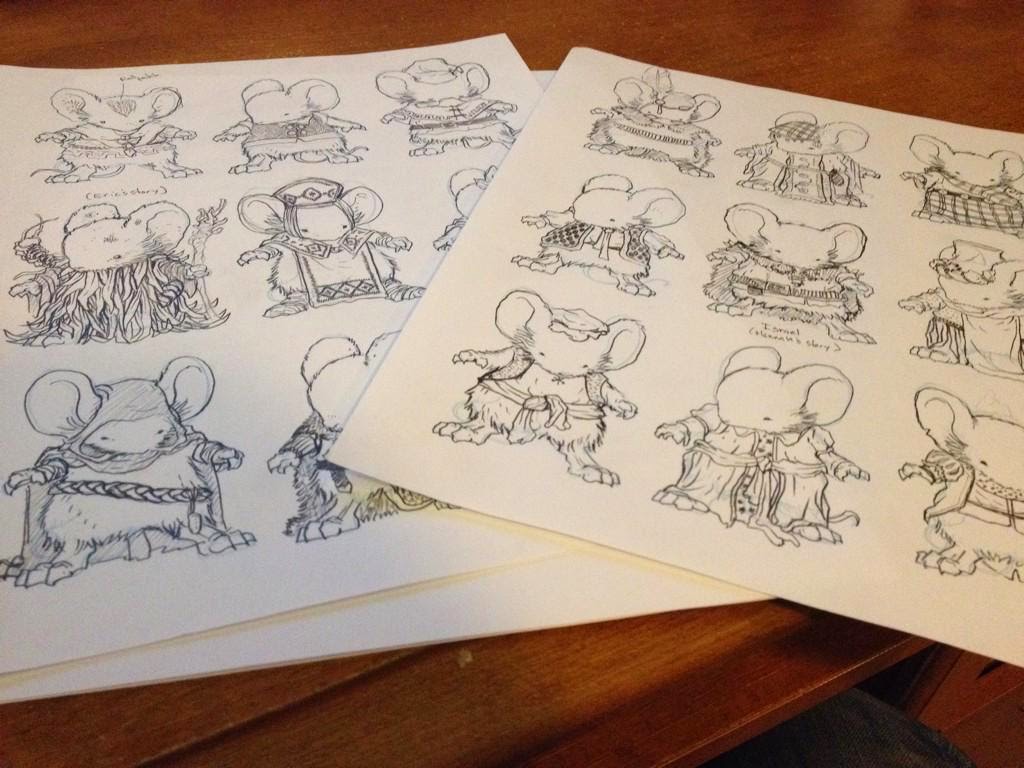
For this week's blogpost, I'll be sharing some previews of in-process work for Legends of the Guard Volume 3 #1 (in Previews this month: Order Code JAN151140). To the left is my wraparound cover for the issue (process post on that cover here). The issue will also be a first for Mouse Guard with variant covers from Humberto Ramos, Ramon Perez, & Eric Muller...but I'll share more on those as we get closer to release. Below are process pages for the three contributors for this issue:

Mark Buckingham:
I chose Mark to be in Legends for obvious reasons. Besides his talent and a delightful person, the body of work he's most known for is Fables which features all manner of talking animals. Mark and I chatted about what he'd like to do for a Legends story sometime early last year, and then again at Baltimore Comic Con towards the end of 2014. I seemed to recall Mark saying something in our earlier talk about doing a story with a goose, at Baltimore, he didn't remember saying that, but liked the idea of drawing a goose. Mark added

"The reason David and I discussed using a goose in my story was due to my inclusion of a goose in medieval costume in the illustration I did for the Fabletown and Beyond Convention poster/T-shirt design, which I remember David telling me he was quite fond of during the show.

I took inspiration for the story title from the Anthony Phillips ( the original guitarist of Genesis) LP "The geese & the ghost" (1977) which has long been a favorite of mine, with beautiful artwork by Peter Cross (Anyone familiar with my work on Fables will immediately spot his influence on me)."Below are Mark's pencils, inks with inkwash, and final art colored by Lee Loughridge for his story The Gosling and the Ghost."


Hannah Christenson:
Hannah falls in to the category of artist/storytellers who are not "names" but do work worthy of much larger attention. I first saw her work online (Hannah's Blog) and kept her in mind as someone to tap as a Legends artist at the first opportunity. After drafting up 5 (!?!) different pitches for Legends, I asked her to pick the one she would be most excited about drawing (since they were all good). Hannah had been taking some blacksmithing classes with her husband and chose to do her pitch that involved a blacksmith for her contribution The Armor Maker. Below are her digital roughs, inks, & colors. Hannah Added:

"Ever since I was a little girl I loved armor, warriors, and knights, and I'd even told my mom I wanted to be a blacksmith when I grew up. I also love stories about "side characters" or the support people outside of the traditional hero who sort of rise up and help in a way they thought was beyond themselves (thus becoming one of the heroes, I suppose).

The process was really awesome on my side of things, from pitching all the stories to working on last edits. I loved all the stories I pitched but I had hoped to get to do this one. I really like armor. "


Skottie Young:
Skottie had originally been tapped for Volume 2 of Legends, but due to a communication error, we thought he was unable to contribute. But we are correcting that with this volume. Skottie loves folklore..so much that his first creator owned series is all about fairy tales (more info about it here)
I don't want to share too much of Skottie's story yet, but it draws from his real life experiences with fatherhood and the wonder of a child. Below are the inks to Skottie's 1st page as a well as a Mouse Guard Daily Doodle of his from back in 2011.


My pages:
I'll be linking the stories together through the storytelling competition at the tavern. So I've been working on designs for the storytellers/inn patrons as well as dusting off my model of the June Alley Inn so I can get my pages turned in on-time.


2015 Appearances:
C2E2 April 24-26
Motor City May 15-17
Denver Comic Con May 22-25
Heroes Con June 19-21
Baltimore Comic Con Sept. 25-27
New York Comic Con Oct. 8-11

Tuesday, June 12, 2012

Mouse Development:


Mouse Development:
While organizing things in the studio, I found a few older drawings of the mice I thought I'd share. They show a progression of how I didn't know what to do with my mouse concept for many years and eventually came to the ink work you recognize in Mouse guard today. If you are not a regular reader of the blog, you can look back at a few past posts about the origins of Mouse Guard and my drawing style before reading on:
Pre-Mouse Guard~1149
Drawing Like Yourself
The Old Guard

In 1996, after the initial drawing of Saxon, Kenzie, and Rand, I painted this on a wide scrap piece of mat board. I remember wanting to show the three as wilderness wanderers and adventurers without them being knights or warriors. It's interesting to me now that the wide horizontal composition, something I pushed for with Mouse Guard by making it a square book, was at the root of one of the earliest pieces I did of the mice. I was still heavily referencing Tom Pohrt's mice & backgrounds for this painting.

By 1997 I hadn't separated the mice out of the larger story concept of my "1149" animal world. While attending community college in Flint, MI, I started writing the animal tales as a chapter book (with the  plan for spot illustrations) I was also taking printmaking at the time, and generated a few etchings of the mice. The first one of the mouse trio (left) was a foundation level assignment where we were only allowed to use one type of ground (acid resist) to make the image.

The second I did as a mock book cover. While writing the first few chapters (which at that time had goats, a tiger, a fox and many other species) I was finding how compelling the mice were to write for. The concepts for their culture were solidifying from a vague altruistic-boy-scout-D&D-ranger to what has since become the inner workings of the Guard on display in my books and the roleplaying game. Using them as the focus of this mock cover not only was the shift for making the stories mostly about mice, but also for this importance of a major winter conflict with weasels.

Over the course of college I was jumping around between tools & techniques I could use to make images. And in the same way, I didn't know what would be the best way to tell my mouse story and jumped between options there as well. As a comic? as a chapter book? as a children's book? This drawing with watercolor wash was done when I was still in chapter book mode. The heavily photo referenced drawing taught me how I would need to draw my main characters without looking up photos of mice on every illustration. The facing page in my sketchbook has the note "the mice rarely trusted weasels, but in this case, they made an exception. Rand walked along ahead to warn of any dangers, Kenzie fashioned a clever saddle pouch from the weasel's bag and belt, and Saxon refused to be out of a sword-swing of the ferret's head in case the new partner was not to be trusted"

By 1998 or so though I had started to cool on seriously doing a mouse story. I was introduced to the Redwall series by Brian Jacques, and saw how someone else was already telling this genre of story with words far better that I could have hoped to. And though I was in school for art, I wasn't confident with my chops as an artist to tell a story mostly with pictures. The characters refused to die in my mind though. So for several years i would just draw the mice, even creating new characters, though I had no serious intent on moving forward with a way to tell their tales. But this causal hobby was allowing me to draw the mice in my own way ...no longer looking at how other artists drew mice or digging up endless photo reference.

After I graduated college in 2000, I had the itch to try telling a story with comics again (something I hadn't had enough time to try while earning a degree). Among other story concepts I considered to play with was Mouse Guard. The rendered pencil work seen above was too time consuming to draw panel after panel of, so I tried drawing the characters with just contour lines. I found the drawing too bland, it needed tone. So I added watercolor (which I overworked and subsequently made the drawing worse by adding). The watercolor went on quicker than fully rendering a pencil drawing, but it was less forgiving. (as a side note, I liked this composition so much I redrew it and used it on the über-rare 2004 MG sketchbook)


It was at a family BBQ where I tried drawing the mice in ink where I found my happy place for the art-style. I had enough experience drawing the mouse characters, I could do it without reference and still make them look like semi-real mice, and I could use cross-hatching and stippling to get all the tone I wanted out of them. With the ink I also got a look of polished-finish that my pencil and water color work always seemed to lack.This drawing (supposed to be me as a mouse) was from that drawing session at the outdoor BBQ. I was calling back my printmaking experience with etchings and woodcuts for "how to make grey tones from black lines" and it just felt right.

There was still a part of me that questioned if I could pull off doing a Mouse Guard story in a medieval setting though. Redwall wasn't only a popular book series, but had an animated series on PBS by this time, and I feared the comparisons. So briefly I toyed with the concept of a rather steam-punk-London-airships Mouse Guard. This character was to be one of our heroes who patrolled a war torn city from mouse spies, running up tall structures to leap into scheduled passing airships. Like James Bond, I wanted him to have a number for a code name, one that suggested there were others like him. This concept wasn't developed more than that, but I do remember while doing this drawing feeling I had a better handle on inking textures and making shapes out of inked negative space.

This last drawing (which butt ends the artwork from the Drawing like Yourself post from last February) was a carry over from the steam-punk idea where I tried to design an Ewok-esque flying rig for the medieval mice. Not only is the rig silly, but I opted to have mice ride birds in Mouse Guard to show the sense of wilderness, setting, and scale.


2012 Appearances:
Heroes: June 22-24
San Diego Comic Con: July 11-15
Baltimore Comic Con: Sept 8-9
New York Comic Con: Oct 11-14
Detroit Fanfare: Oct 26-28

Tuesday, April 17, 2012

Pre-Mouse Guard~1149


Before Mouse Guard was Mouse Guard, I had an idea for an animal story that was more akin to Disney's Robin Hood than what Mouse Guard is today. It was a way for me to get to have fun with animal characters which I enjoyed drawing, and have a way to script out stories like the roleplaying adventures my friends and I were playing. I started working on this around my freshman year of high school, when my friends and I were making up all sorts of comic characters and stories (including Cats Trio) The comic was to be called 1149, referencing a date in the middle ages (which was also the starting year of one of my favorite computer games: Defender of the Crown)

The characters:
A Fox who got by in life by conning kings into thinking he was royalty, getting invited to their castles, and then making off with their treasures in the middle of the night. A tiger, who was a monk that had strayed from a religious path (in a violent rage fueled event) and became a wandering adventurer because he was no longer welcome at his monastery. A duck who was a grumpy butcher and was the most fearsome merchant in his village. A ferret archer who was exiled from every kingdom and lived in the wild. There was also a bear character, a rabbit, and an opossum who were never fully fleshed out. These drawings represent the earliest versions of the characters.

As high school went on, my friends and I would rotate duties on various comic projects we were dreaming up, but the next time I got back around to these characters, I honed in on the tiger, fox, duck, and ferret. They were going to be my main cast (I also planned on keeping the opossum at this point, but I can't find any drawings of her). I was trying to draw these characters consistently (which is probably why most of these are drawn in profile, as though I was prepping to do turn-around model sheets), because that summer, I started drawing the first 8 pages of 1149 while on a summer trip. Unfortunately, none of those pages survive today.

Towards the end of high school and into the start of college, I did another batch of re-designs on these characters. I was using new materials to draw and color with, and had learned from getting several false starts with comics in high school, that a streamlined design for the characters will only help you draw the story more comfortably. I think this was some of my first realizations about drawing like yourself being easier than trying to mimic other folks (even your friends)   This was marked the last time I tried to draw them with the hopes of 1149 being a comic series.

While in my first year at college I started a re-write of 1149 from the ground up, and had plans for it to be a novel series that I would also illustrate. I expanded the species list (to also include a civilization of mice) and tried to find a sensible way of honoring some of the old characters while still explaining why their species would be on the same landmass as the others. I painted these as character portraits to inspire me as I wrote. The first chapter dealt with two monk rams who found the half dead body of a tiger in a snowstorm on their monastery's mountain. The two rams debated whether to care for or kill the beast. Chapter two started off with three mice: Saxon, Kenzie, and Rand...

In 1996 I also drew three ranger-esque mouse characters for the novel I was starting to write. Saxon, Kenzie, and Rand represented myself and my friends Jesse & Mike. They also represented Sword, Wisdom, and Shield...or to put it another way, aggression, calm, and defense. By developing what their group of Guardmice did, why it was there, and how it functioned, I realized the heart of this story had to be the mice. They were the ultimate under-dog, their struggle was more interesting and important than any of the other species. I dropped the idea of the predators as characters away, and kept them as races meant only to be the threat...of the Mouse Guard.

2012 Appearances:
Boston Comic Con: April 21-22
FCBD: Jetpack Comics: May 5th
Heroes: June 22-24
San Diego Comic Con: July 11-15
Baltimore Comic Con: Sept 8-9
New York Comic Con: Oct 11-14
Detroit Fanfare: Oct 26-28

Tuesday, February 21, 2012

Drawing like yourself:


Yesterday on Twitter I posted an image of the first Mouse Guard drawings I ever did back in 1996. I followed that tweet with the statement:

"The artwork moved away from that style...I needed to develop my own work, & not copy the style of someone I admired. When I learned to 'draw like myself' better things happened"

In 2003 I was at a family bbq, and drawing the mice. I did the drawings in ink & fell onto my etching techniques to make grey tones and interesting patterns. Instead of mimicking my favorite artists and illustrators, I was drawing like myself, and building on work & techniques of my own to push the drawing out somewhere new.

These drawings were also part of the very very first Mouse Guard sketchbook that pre-dated my self-published black and white issue of Mouse Guard in 2005. The first time I set up at the Motor City Comic Con was in October of 2004. I was going to be an artist at an artist alley table, with no book and no previous working experience. All I had were pieces of artwork I made as a fan, for fun, and my own concepts and ideas. Using my home printer, I printed out samples of pieces I'd done. Everything from watercolors of superheroes to pencil drawings of fantasy characters, and of course, some Mouse Guard images.

I've posted and talked about these c.2003 Mouse Guard drawings before, but never in the context of them having been printed in a sketchbook. I printed 2 versions of the same book through my home printer. One was 1 character wide and rather tall, the other (after realizing it was a pain to trim every page by hand) was 2 characters wide so that the width matched the paper size. I added some text to the backgrounds of each character (most of the text was a description of the character or their name's meaning). In total I printed between 4 and 7 of them for that convention, and I have none left now.

I mention this sketchbook because a fan came out of the woodwork having recently acquired one and couldn't find any information online about what it was, when it came from, or how many were printed. Now I really hope that me typing this up doesn't lead to a few going up on ebay and other fans getting milked (I posted all the images from that sketchbook here so that no one would have to pay top dollar to see the contents) However, I know I can't stop a free market with driven completist comic book collecting fans. I merely wanted to share a bit of history, that, up to this point, I have never publicly mentioned.

I'd also like to echo what I said in the opening of this post, when I stopped trying to draw like the people I admired, and just used their work to inspire me to do better (instead of doing knock-off attempts at their work) better things happened for me, and these drawings represent that. I'm not done trying to be better and learn about my own process. I review recent work of mine to see what was working and what wasn't so that I can build off of the successes and keep making things better. It's advice I think that works no matter what creative field you are in. Be yourself.


*Edit*

I'd like to supplement this post with a series of tweets from after this entry was originally posted:

Part of 'drawing like yourself' involves closing off influences for a while & relaxing while you draw. Almost like going into zen-autopilot 

It's ok to learn something by copying and emulating, but at some point you have to shut Artist X's book and draw something of your own

Emulating should be about understanding the deeper decisions Artist X is making: why that composition, why that lighting, why that form..etc

You should have a list of influences as long as your arm. If you're targeted on 1 Artist X, your focus is too narrow. Get wider inspiration

Use the 'why' lessons you gained from artist emulations/study & keep them in your back pocket as you ask yourself 'why' about your own work

Use your own decision making process about the 'why' of what goes on your paper to filter all the inspirational ideas/influences/whys

I think young people wanting into comics & illustration try to emulate what those industries already have. no, we want to see something new!

My thoughts on 'drawing like yourself' come from being a former emulator who tried really hard to be someone else (several times) & failing

It took time to 1st overcome the fear of drawing naturally & then more time learning HOW to draw naturally. Give yourself permission & time

**Edit 2** 
While exploring and old file folder, I found a copy of the sketchbook! The cover is a light grey thick stock and the pages are a faux parchment. The original price sticker is still on the cover, and instead of folding paper in half to 'saddle stitch the binding, I just staped the single sided pages together with red staples along the edge. This is going into my personal archive & is not available.


2012 Appearances:
London Super Con: Feb 25-26
Forbidden Planet London signing: March 1
Comics & Graphics Berlin signing: March 3
Comic Combo Leipzig signing: March 5

Emerald City: March 30-April 1
C2E2: April 13-15
Boston Comic Con: April 21-22
FCBD: Jetpack Comics: May 5th
Heroes: June 22-24
San Diego Comic Con: July 11-15
Baltimore Comic Con: Sept 8-9
New York Comic Con: Oct 11-14
Detroit Fanfare: Oct 26-28

Blog Archive